
When answers are everywhere, what will our students still need to be able to do themselves?
AI should expand what students can think through, create, and explain.
Teachers keep teaching. They also plan for more learner choice, reflection, and self-direction over time.
Children build understanding with others, and support works best when it fades as they become capable.
AI and teachers ask questions back instead of handing over answers. Students explain to a peer before they accept an idea.
Seed class: the teacher turns an AI suggestion into a question the class tests together.
Grounded in: Vygotsky (1978); Wood, Bruner, & Ross (1976); Alexander (2008)
Noticing what you know, what you doubt, and what to do next is a skill that can be taught.
Prompts ask: How sure am I? What would change my mind? What changed in my thinking?
After finding a flaw in an AI explanation, students write what they now think, and why.
Grounded in: Flavell (1979); Zimmerman (2002)
Using an idea somewhere new is the real test of learning, and it rarely happens on its own.
Name the principle, vary the examples, then check a new case without AI or scaffolds.
After explaining a disappearing puddle, students explain a sweating cold glass alone.
Grounded in: Perkins & Salomon (1992)
Design for reasoning you can see, and AI use becomes something to discuss, not hide.
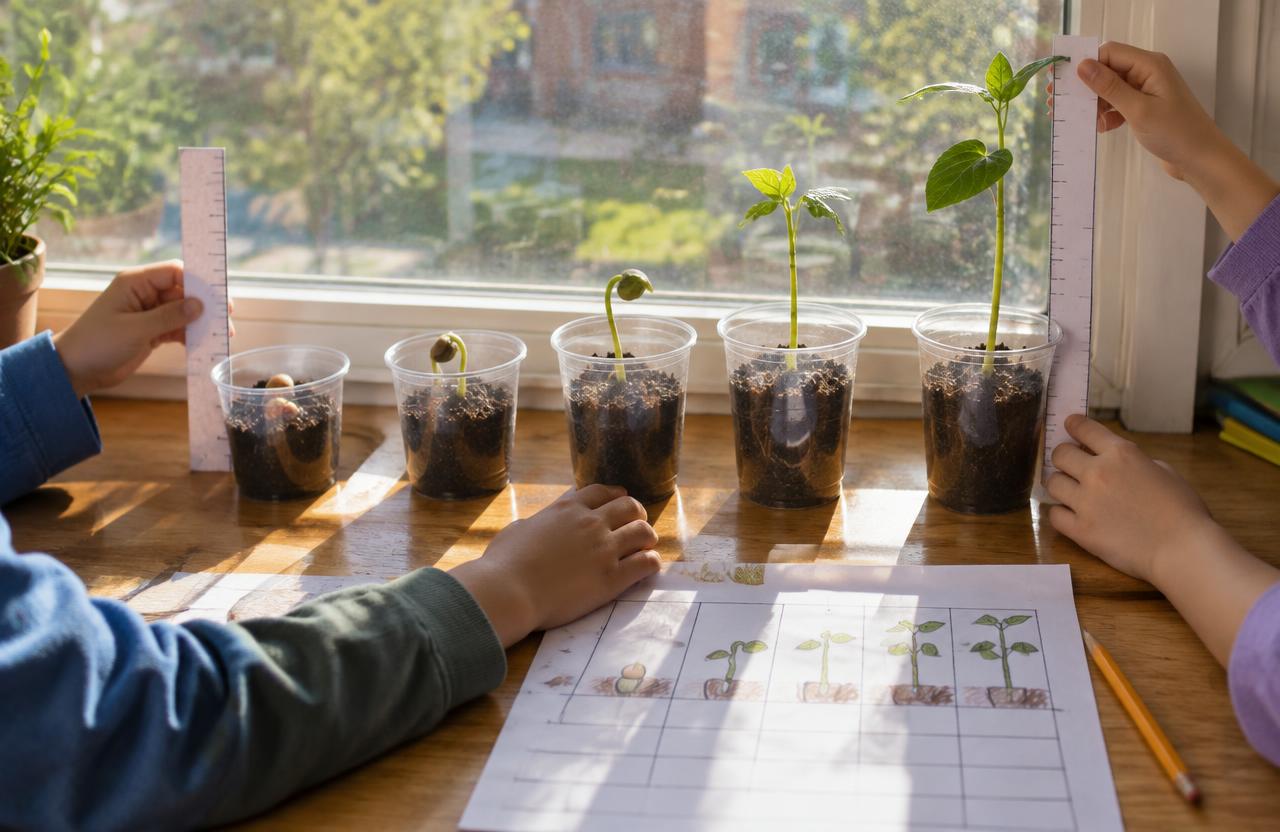 Fictional classroom example
Our window cups grew taller. I asked AI why. It said light, water, or warmth. Which can we check?
Light! The window cups get sun. The shelf cups don't.
But we watered them all the same. How do we know?
We used the same cup. We could move two shelf cups to the window and see.
Students write: which claim fits, which needs a qualifier, and what evidence convinced them.
Source A is a mill owner's letter. Source B is a worker's diary. Both describe the 1890s flood in a fictional town.
Both sources show the town recovered quickly and everyone worked together.
The diary says workers waited weeks for wages. That's not everyone recovering quickly.
The owner had reasons to sound positive. I'd say recovery was uneven, depending on who you were.
You said the puddle disappeared because the sun dried it. Where did the water go?
Into the air, I think. As vapor.
What would you expect on a cloudy, cool day? Reconsider your explanation.
It would take longer. Heat speeds evaporation but isn't the only reason.
Safe, small experiments. Baselines: observations, reasoning samples, teacher workload.
Supported practice spreads across teams. Students evaluate and justify more.
Students question, judge, and transfer more independently.
An aspiration, not a forecast. Observations, reasoning samples, independent work, reflections, and workload notes inform us; alone, they do not prove cause.
Before Friday, try one WALK step with one class or one team.
Write your step at the bottom of the canvas. Tell a colleague.
Teachers design the conditions; students increasingly shape the learning.
Want ready-to-use routines? Join us this afternoon.
AI-Assisted Learning That Gets Students Thinking: four classroom routines, hands-on practice, no device needed. Plus prize giveaways, so do not miss it!
Try the community free for seven days: take a course, connect with colleagues, and keep building your professional practice.
lcs2026dbfl.lovable.app/join · Seven-day free trial

What would make this work in your building?
Where do you see risk?
What support would teachers need first?
AI should expand what students can think through, create, and explain.